
The UniCredit Experiment: Can Europe Finally Build a Truly Cross-Border Bank?
Andrea Orcel transformed UniCredit. Commerzbank now turns that corporate success story into something much larger: a test of whether Europe actually believes in its own single financial market.
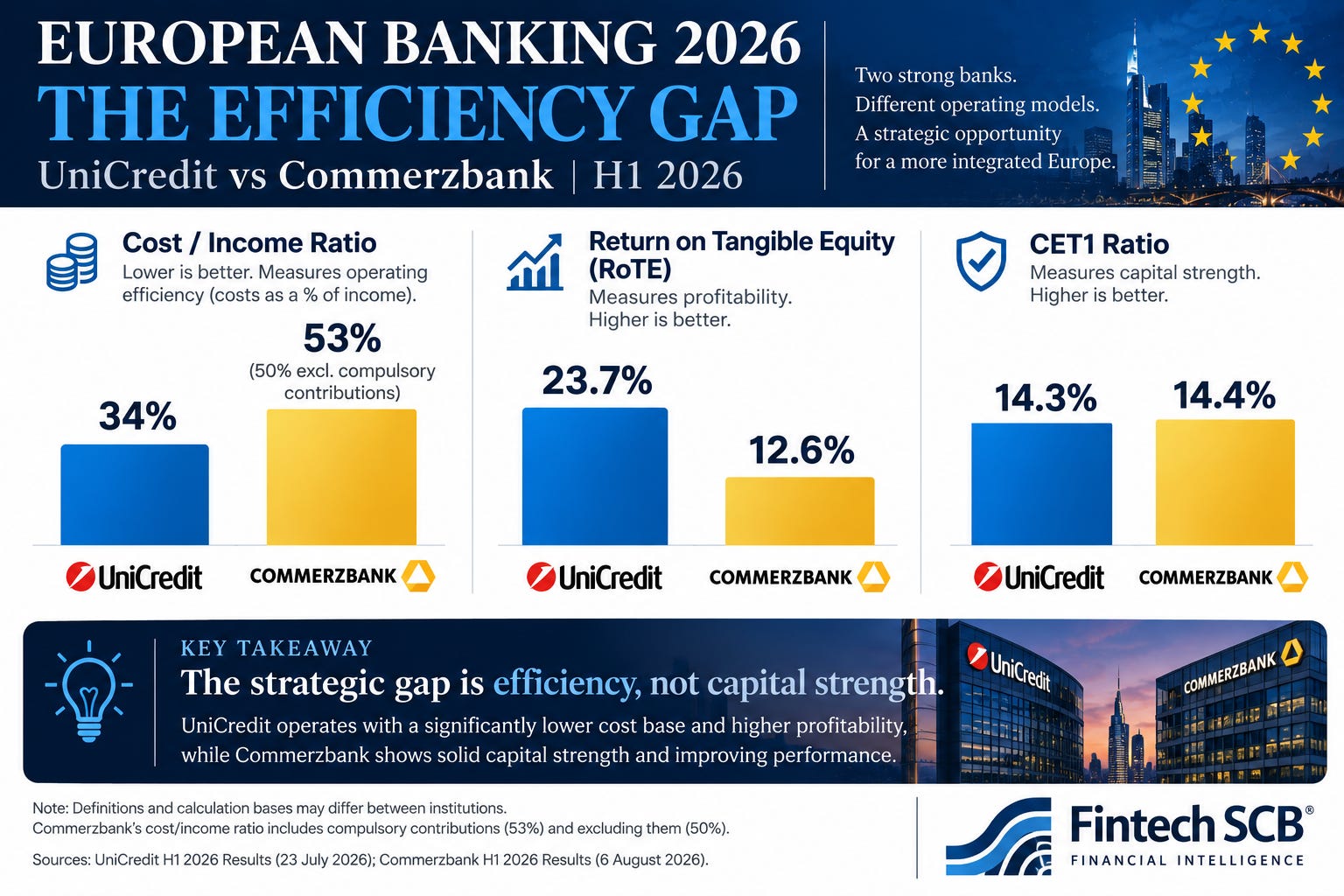
European banking has spent years discussing consolidation, scale, Banking Union and the need to compete with American financial institutions.
The rhetoric has always been ambitious.
The architecture has been considerably less so.
Europe has a single currency across much of the continent, a common central bank and common banking supervision for the euro area. Yet banking itself remains remarkably national.
The European Central Bank recently put numbers on the contradiction: around 80% of bank lending to households and companies remains domestic, while less than 2% of deposits are held across national borders. The ECB’s conclusion is unusually direct: Europe still does not have a genuinely integrated banking market.
That is why the battle surrounding UniCredit and Commerzbank matters far beyond Milan and Frankfurt.
It is not simply another banking takeover.
It is becoming a practical test of whether European financial integration exists when someone actually tries to use it.
First, understand what happened to UniCredit
Andrea Orcel took control of UniCredit in 2021.
The transformation since then is difficult to dismiss as financial-market enthusiasm alone.
By the first half of 2026, UniCredit reported a 34% cost-income ratio, while revenues and profitability continued to grow. The bank described the period as its best first half on record and upgraded its 2026 net-profit ambition to well above €11 billion, or around €11.5 billion excluding integration costs.
That combination matters.
Banks can increase profits by taking more risk.
They can improve capital ratios by shrinking.
They can reduce costs while damaging the franchise.