
THE SUNDAY LONG READ Canada’s Prosperity Paradox
Why growth is not reaching households—and what Europe could offer.
By FINTECH SCB | Financial Advisory & IntelligenceResearch cut-off: 7 October 2026
Canada possesses many of the assets the global economy increasingly needs: energy, minerals, agricultural capacity, technical expertise, established financial institutions and political stability.
Yet its economic story becomes less comfortable when we move from the size of the national economy to the progress experienced by individual households.
One comparison captures the problem particularly well.
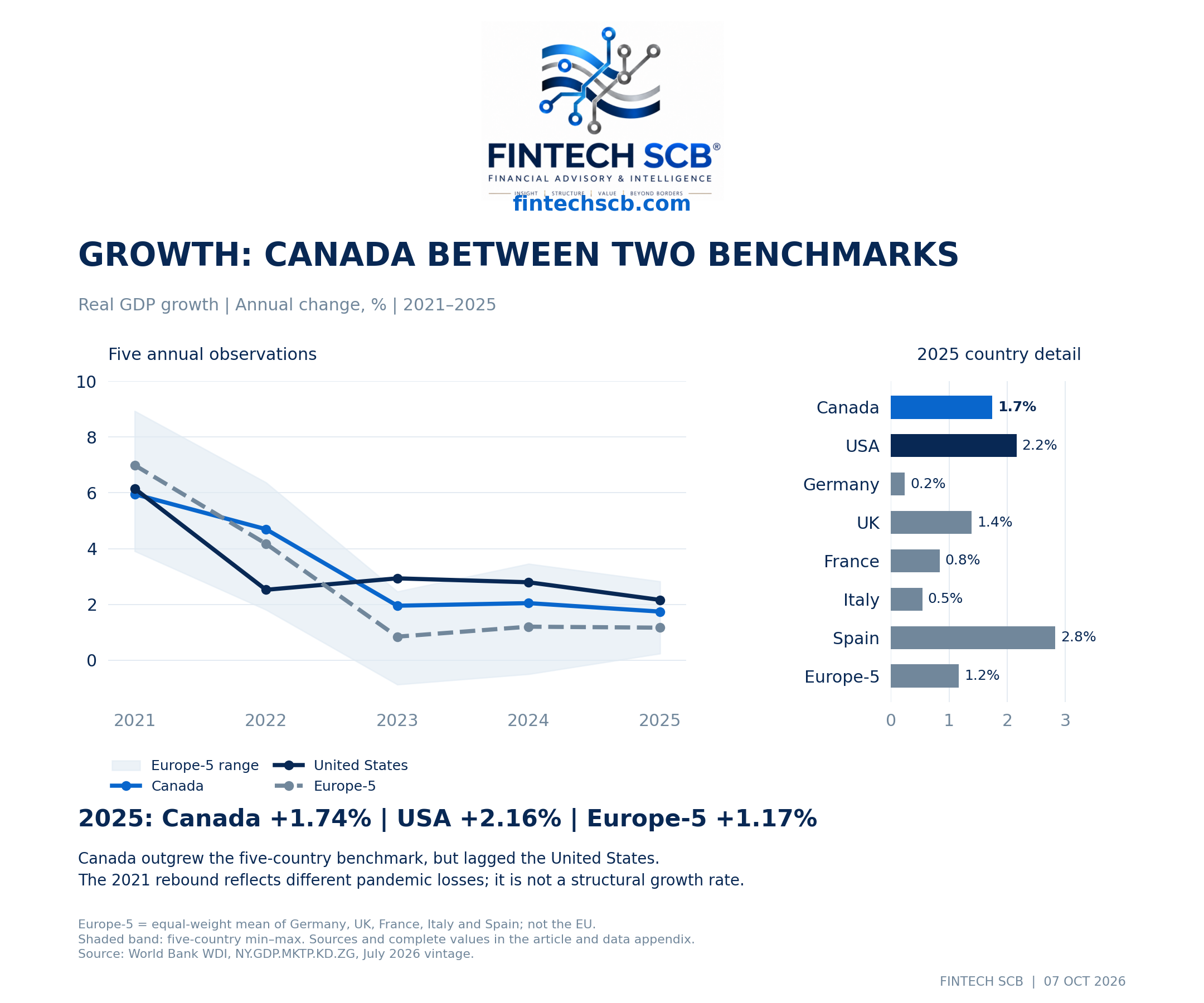
Between 2021 and 2025, Canada’s total real GDP increased by approximately 10.8%, almost exactly matching the cumulative increase in the United States. But real GDP per person rose by only 1.7% in Canada, compared with 7.7% in the US.
Similar growth in the overall economy produced very different results per resident.
That gap helps explain why positive national growth figures can coexist with frustration over housing, wages and living standards. It also explains why the debate about Canada cannot begin and end with American tariffs.
Trade restrictions have made the country’s weaknesses more urgent. Several of those weaknesses were already visible before the latest trade conflict.
To understand Canada’s position, we need to connect subjects that are often discussed separately: immigration and housing; exports and productivity; tariffs and investment; wages and disposable income.
We also need to ask a more precise question about Europe.
A deeper economic relationship with the European Union could offer meaningful opportunities. Formal EU membership would be a radically different proposition, with extraordinary legal obstacles and substantial economic trade-offs.
This Sunday Long Read examines the Canadian economy from its foundations to its strategic choices, comparing its recent performance with the United States and five major European economies.