
The Rules Behind Private Credit
Regulation moved the lender
A company needs a five-year loan. Its machines, customers and cash flows have not changed. Yet the institution willing to provide that loan has.
The bank asks for more collateral, a shorter maturity or a different price. A private credit manager offers a bespoke facility, a negotiated covenant package and a relatively quick decision. The transaction is announced as another example of financial innovation.
It may be. But something less glamorous also deserves attention: the rules changed the relative cost of being the lender.
That distinction matters. If private credit expands because it evaluates borrowers better, the economic story is about productivity in finance. If it expands partly because banks face a different regulatory cost, the story also concerns the design of the financial system. Both mechanisms can operate together.
My argument is that private credit should be assessed as part of a connected financing system. Its success cannot be understood solely through fund returns, and its risks cannot be understood solely through the absence of deposits.
The interesting question is what happened to the borrower, the funding promise and the ultimate loss bearer when the loan changed address.
What the new evidence establishes
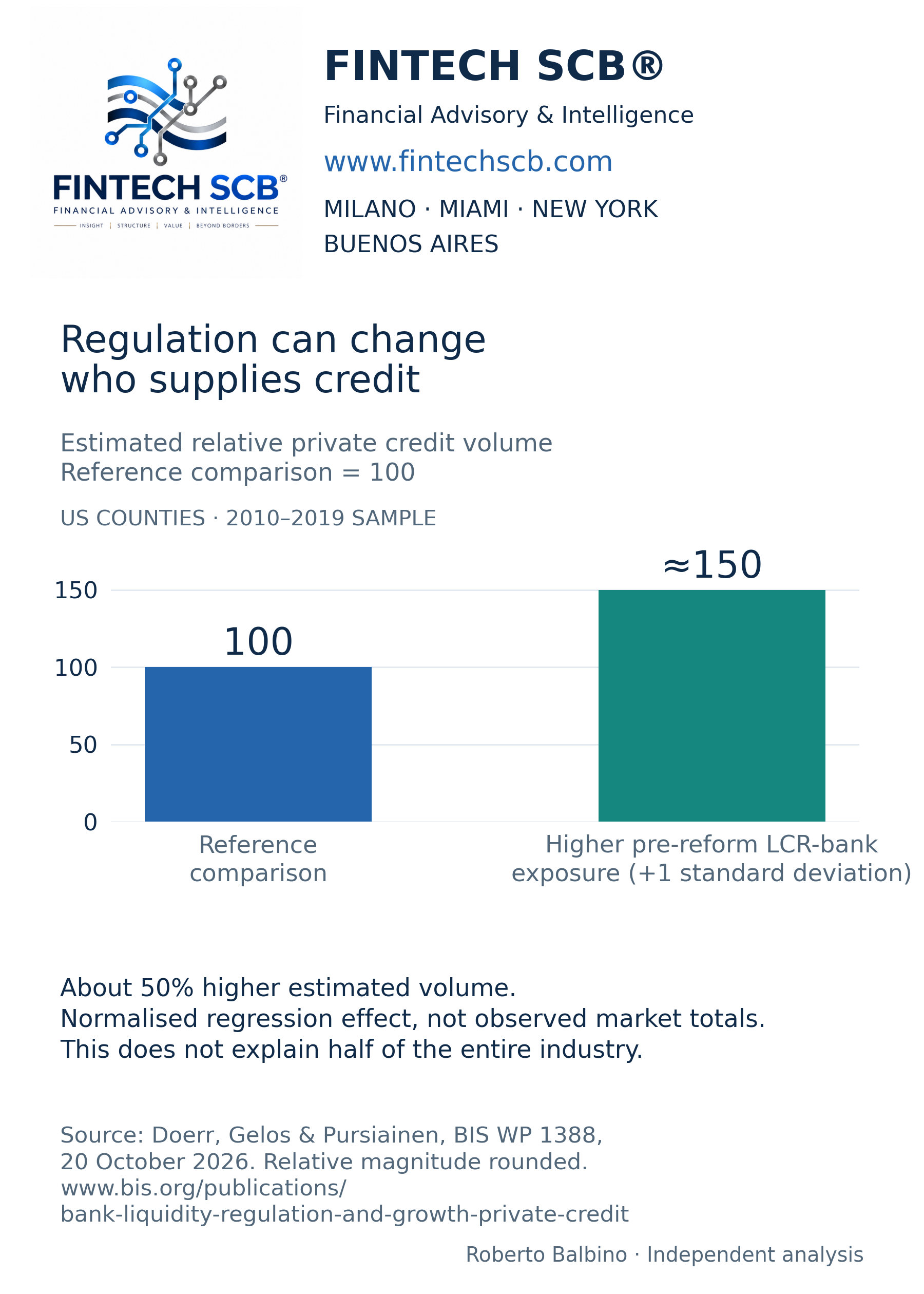
A BIS working paper published on 20 October 2026 examines US counties over 2010–2019. Sebastian Doerr, Gaston Gelos and Vesa Pursiainen find that a one-standard-deviation larger pre-reform footprint of banks subject to the Liquidity Coverage Ratio was associated with nearly 50% higher subsequent private credit volumes in their estimation. The design uses local banking exposure before the reform to study subsequent changes. [1]