
The restructuring dividend: who gets paid when the workforce gets smaller?
Deloitte’s 45% pay rise, the incentives inside Salesforce’s margin targets, and the question boards should answer before rewarding a transformation.
Roberto Balbino | Fintech SCB
“Our people are our greatest asset” is an easy sentence to publish. A remuneration report is a more demanding place to test it.
The Financial Times reports that Richard Houston’s remuneration at Deloitte increased by 45% to £7.1 million in the financial year ended May 2026, after the firm reduced its UK staff by 1,000. Over the same financial year, UK and Swiss revenue increased by 2%, while distributable profit rose by 14%.[1–3]
The juxtaposition invites an immediate response: people leave, leadership receives more. But the more useful question is how a business decides that a restructuring has created value, and when the people who approved it are entitled to collect the reward.
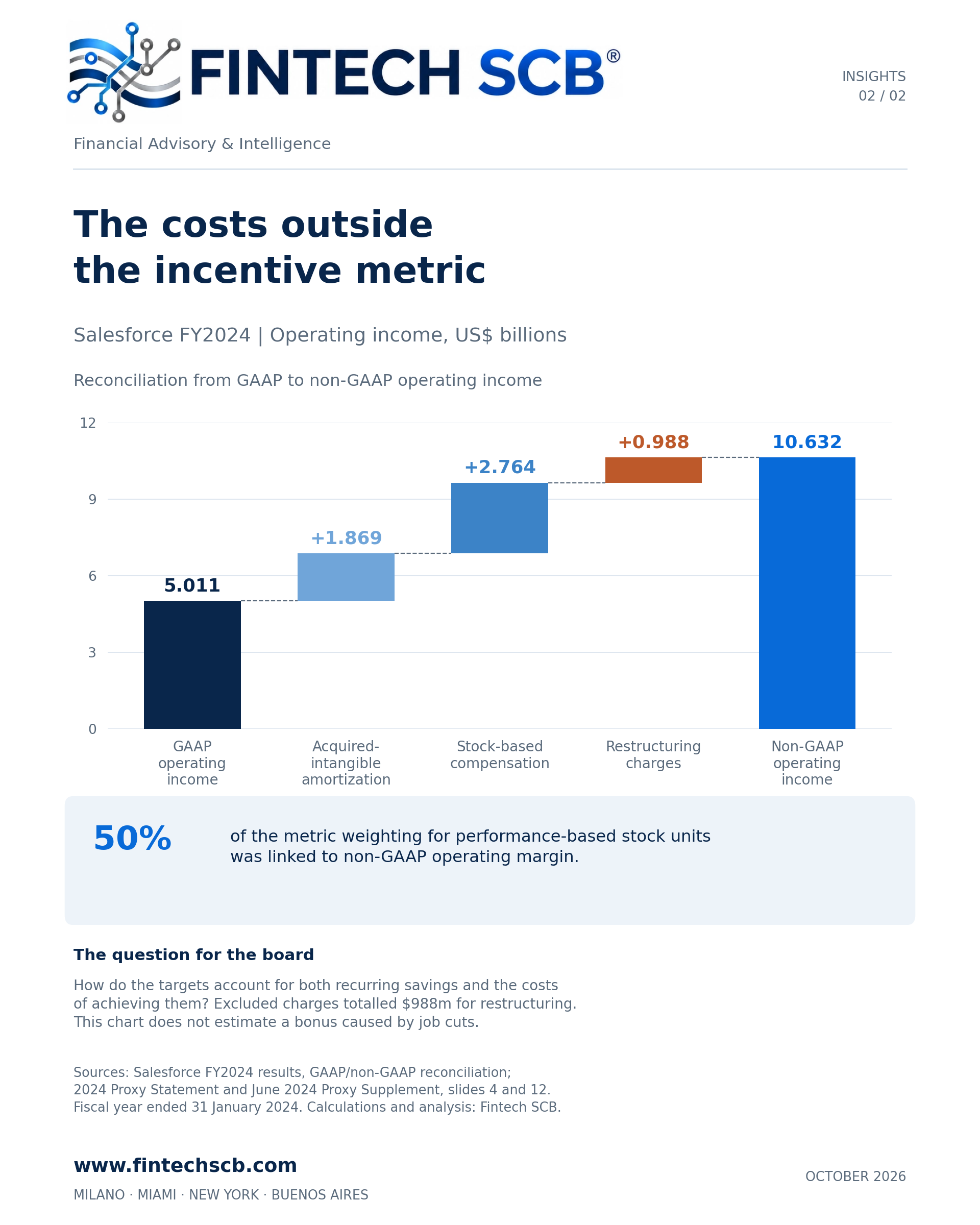
My thesis is that remuneration can recognize the visible benefit of a workforce reduction before the organization has adequately measured its full consequences. The risk is greatest when savings improve an incentive metric, while some of the costs are excluded, deferred or difficult to observe.
A second issue concerns the allocation of the gain. A larger personal payout can reflect a better operating result, a larger share of that result, or both. Assessing leadership requires separating those channels rather than treating remuneration growth as evidence of productivity.
This is an argument about the design of incentives. It is also an argument about the distribution of economic gains. It does not require assuming that every workforce reduction is wrong, or that every executive receiving a large award has been paid specifically to dismiss employees.