
The Privatization of Growth
What happens when the public market arrives too late
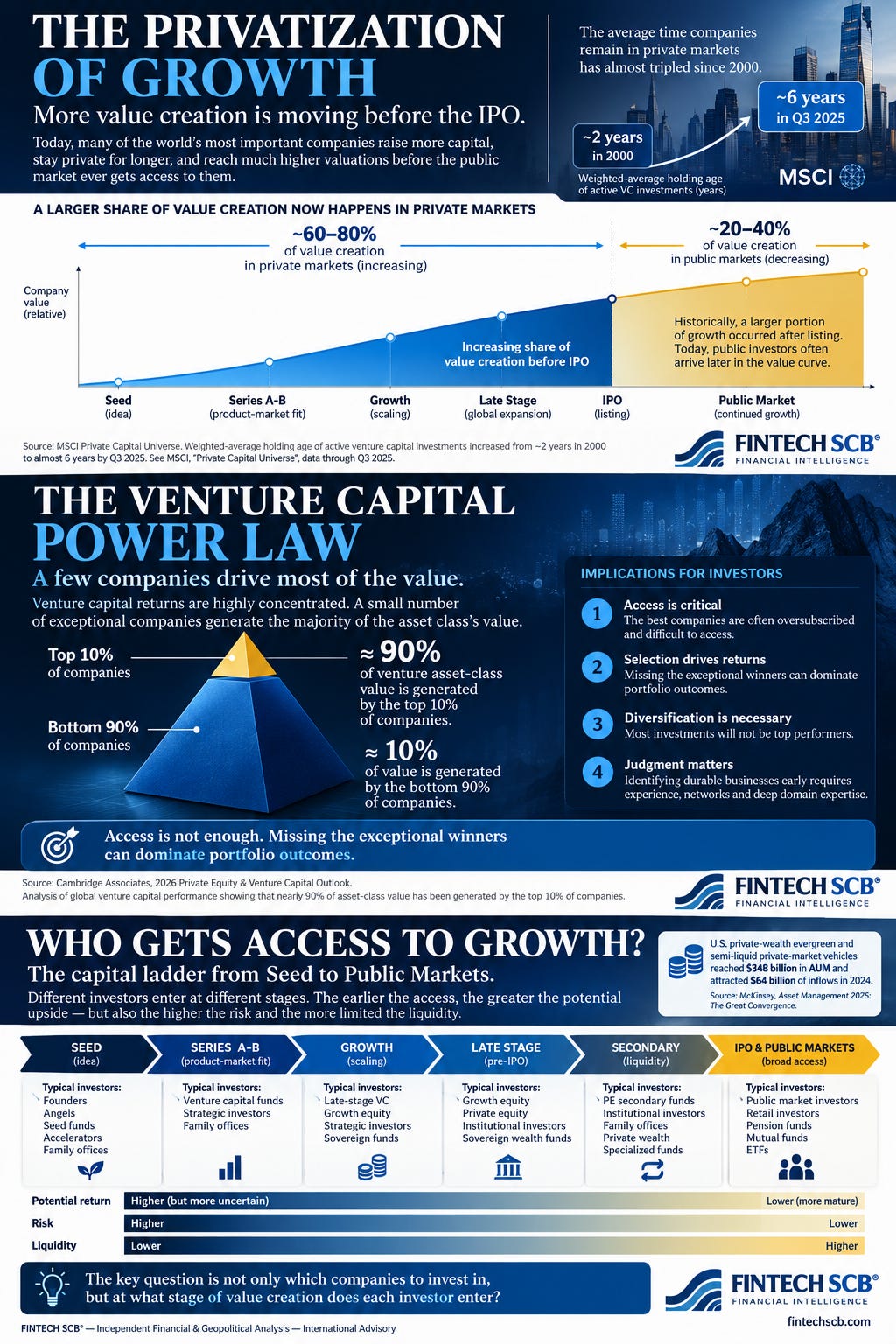
The most important companies are increasingly being financed, scaled and repriced before ordinary investors ever get access to them.
For most of modern financial history, the stock market performed two functions at the same time.
It provided companies with capital.
And it allowed the public to participate in their growth.
A successful company might begin with private capital, but eventually it would enter the public markets while a substantial part of its expansion was still ahead of it.
That architecture is changing.
Today, some of the world’s most important companies can raise billions of dollars privately, remain private for many years, develop global businesses, acquire competitors, build infrastructure and reach valuations once associated almost exclusively with listed corporations.
By the time public investors finally receive access, a remarkable amount of value creation may already have occurred.
This is not simply a story about venture capital.
It is a structural transformation of capitalism.
And the central question is becoming increasingly uncomfortable:
Who gets access to economic growth before it becomes public?
1. Companies no longer need the stock market as early as they once did
The traditional corporate financing ladder was relatively straightforward:
Founder capital.
Angel investors.
Venture capital.
Growth capital.
IPO.
Public markets.
The IPO represented a transition point. It provided liquidity to early investors while opening the company’s next stage of growth to a much broader investor base.
But the enormous expansion of private capital has changed that equation.
Private equity, venture capital, sovereign wealth funds, family offices, pension funds, private credit funds and large institutional investors can now finance companies at a scale that previously would have required public markets.