
The One-Cent Payment Myth
Cheap rails. Costly exits.
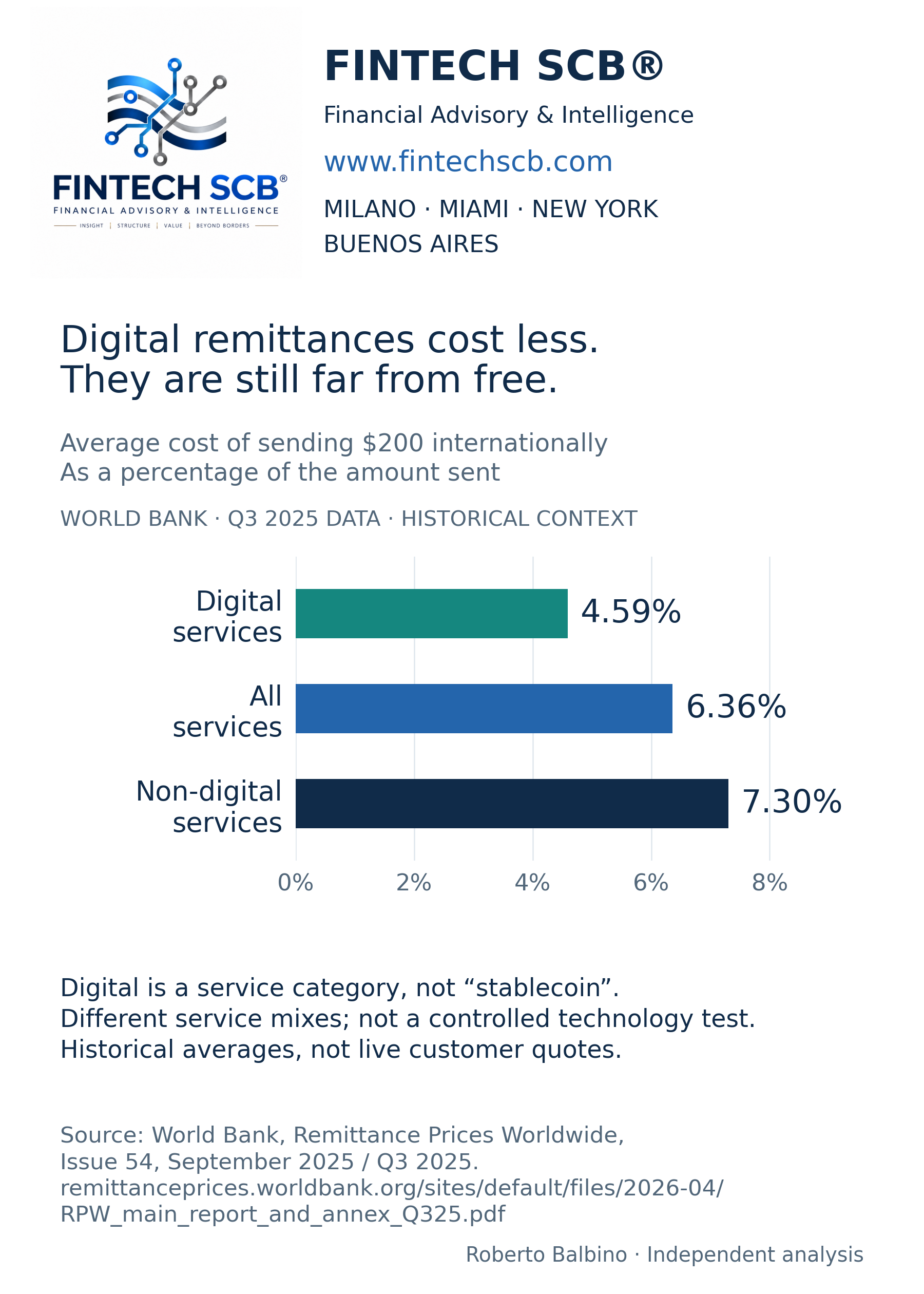
A payment travels across a digital network for one cent. The demonstration is impressive. The recipient still needs to turn the balance into money that pays the rent.
That final step is where a technological claim becomes an economic proposition.
The relevant question for a customer is how much spendable money arrives, in the required currency, by the required time, after every charge. A network fee can be genuinely tiny while the complete service remains expensive. A traditional provider can also advertise a modest explicit fee while earning substantially more through the exchange rate.
Neither a blockchain demonstration nor a bank’s fee schedule settles the comparison.
My argument is that the next serious stage of payment competition should be judged at the recipient’s end of the transaction. This requires accounting for conversion, access, liquidity, service reliability and recourse alongside the mechanics of transfer.
That test may favour a bank, a fintech or a stablecoin route in a particular case. It is more demanding than choosing a favourite technology, and considerably more useful.
The research behind the debate
A BIS paper published on 19 October 2026, by Wenxin Du, Catherine Huang and David Scharfstein, examines banks, fintechs and stablecoins through the combination of foreign-exchange markups and explicit charges. The stablecoin route includes conversion into a token and back into conventional money. [1]
The accompanying discussion by Tobias Adrian cautions that comparisons do not always match corridors, transaction sizes, dates and cost components. He notes evidence of stablecoin advantages in some comparisons, with substantial variation. These are research positions, not a simple institutional verdict declaring one technology the winner.