
THE ITALIAN TAX SCANDAL
When 30% pay almost 80%
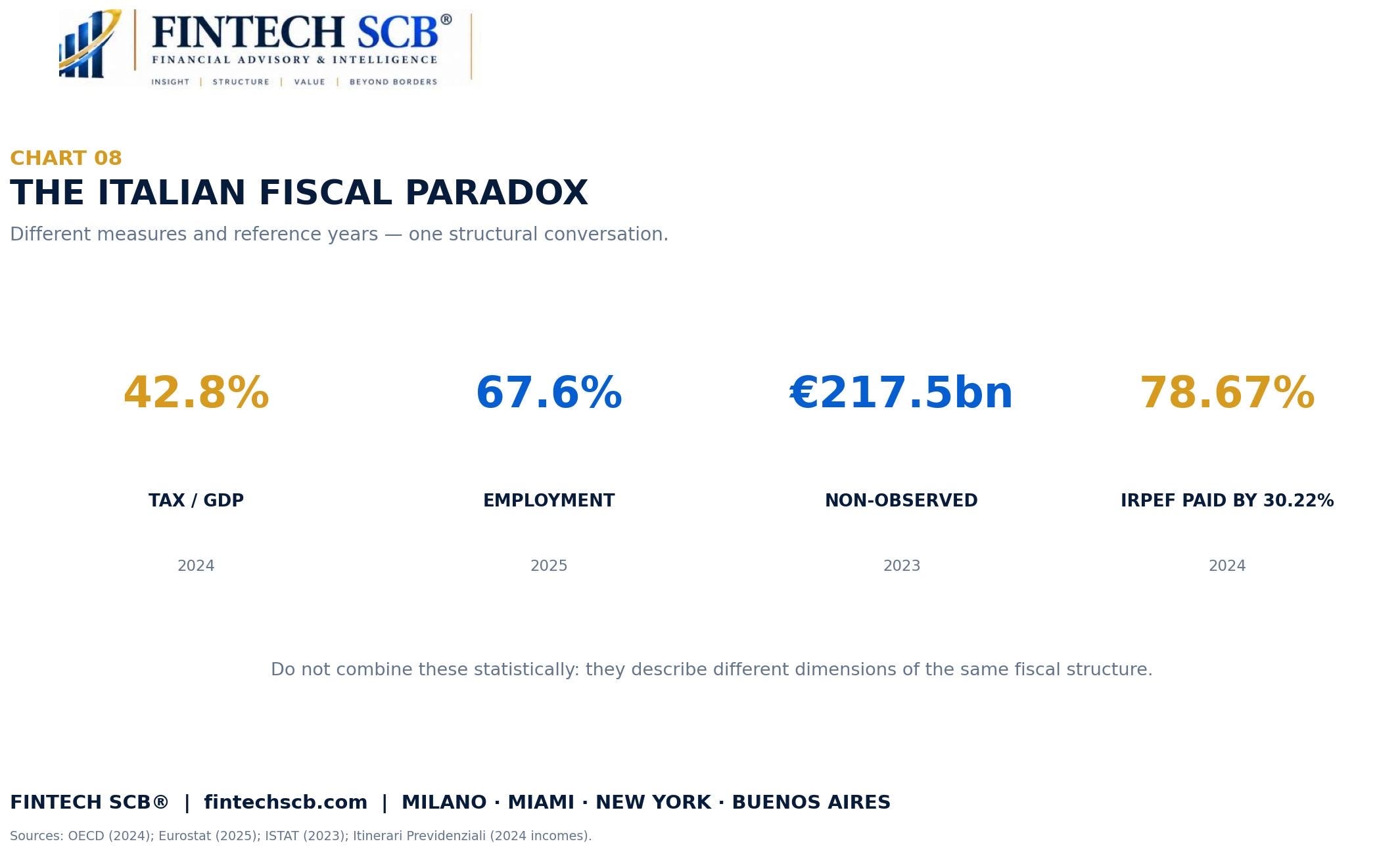
There is a version of Italy that exists in the real world, and another that appears in its tax returns.
The first is a G7 country. One of Europe’s great manufacturing economies. A nation of globally competitive exporters, expensive property, substantial household wealth, successful entrepreneurs, professionals, luxury consumption and industrial districts capable of competing almost anywhere in the world.
Then there is the Italy described by personal income-tax declarations.
And the two pictures do not fit together particularly well.
The latest figures on income earned in 2024 are remarkable. Italy had approximately 42.84 million IRPEF taxpayers. Only around 34.1 million actually paid net IRPEF.
But those numbers are merely the beginning.
Taxpayers declaring no more than €20,000 represent approximately 47% of the total. Together, they account for only around 5% of IRPEF.
At the opposite end, just 745,615 taxpayers declare more than €100,000.
That is 1.75% of taxpayers.
They account for 22.25% of IRPEF.
And then comes the number that, in my view, should force Italy to have a much more serious conversation about taxation:
30.22% of taxpayers account for 78.67% of IRPEF.
Not the richest 1%.
Not billionaires.
Not some tiny class of oligarchs.
Thirty percent of taxpayers.
Almost eighty percent of personal income tax.
That is not ideology.
It is arithmetic.
1. THE ITALIAN TAX PYRAMID IS BECOMING A FUNNEL
The deeper one goes into the numbers, the stranger the structure becomes.
There are approximately 42.84 million taxpayers.
Only around 34.1 million have positive net IRPEF.
Approximately 8.7 million taxpayers therefore have no net IRPEF liability.