
The Global Economy Is Growing. But Who Actually Owns the Future?
Brazil, Mexico and Argentina face different problems. Latin America’s common challenge is turning economic advantages into prosperity that lasts.
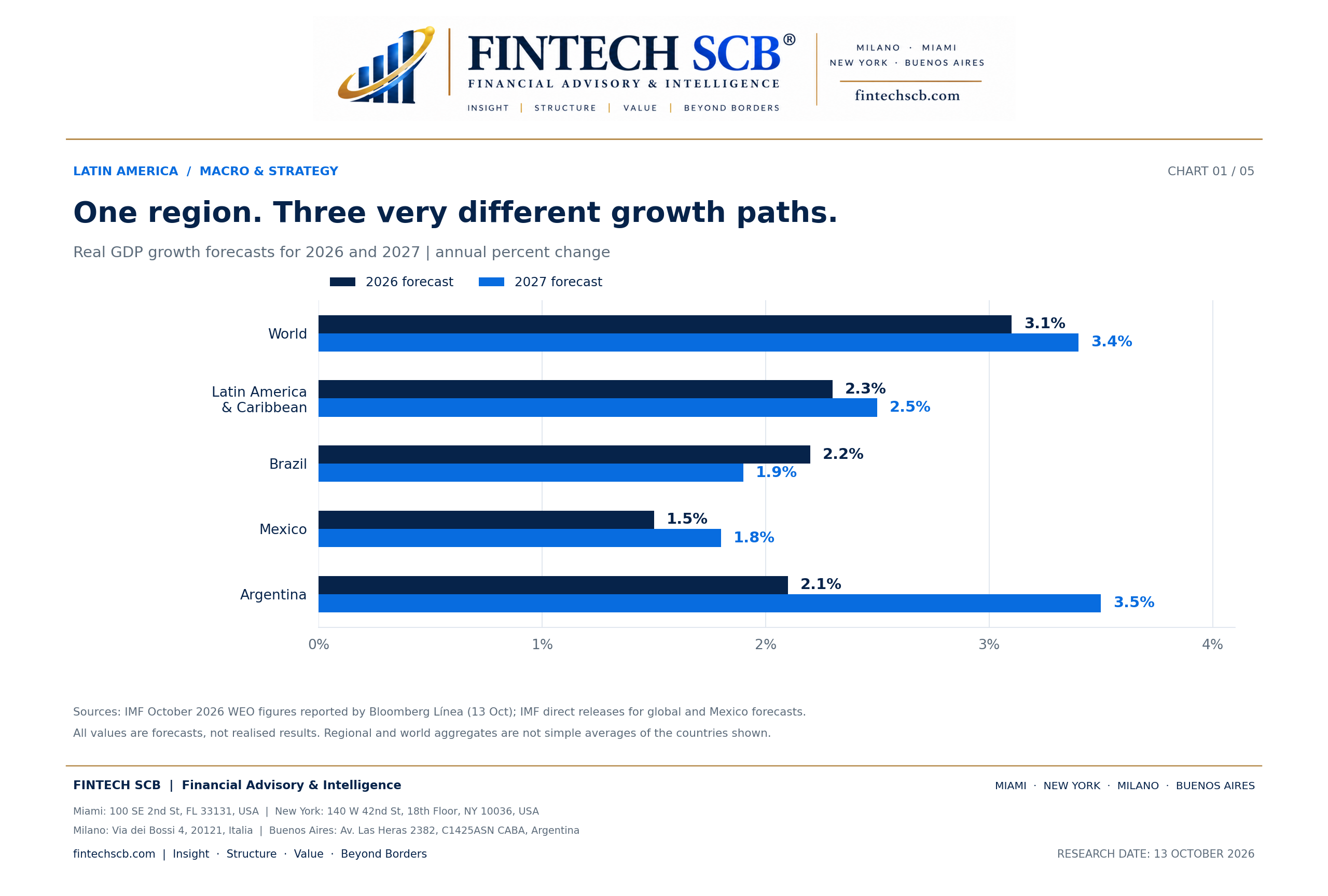
Latin America does not need another reminder that it has potential. It needs a more demanding definition of success. A country can export more, attract investment and register another year of positive GDP growth without fundamentally improving the opportunities available to its citizens. A recovery can repair yesterday’s damage without creating tomorrow’s productive capacity. And an economy can participate in a technological revolution without capturing enough of its benefits to transform living standards. These distinctions matter when reading the latest growth forecasts. The IMF projects global expansion of 3.1% in 2026 and 3.4% in 2027. Its October assessment describes an increasingly uneven world: technology-related investment cushions some economies, while energy costs and other shocks weigh more heavily on others. [1]
For Latin America and the Caribbean, the corresponding forecasts are 2.3% and 2.5%. Within the region, Brazil is projected to grow by 2.2% and 1.9%; Mexico by 1.5% and 1.8%; and Argentina by 2.1% and 3.5%. These are forecasts, not completed economic achievements. [2] The temptation is to turn those figures into a league table. Argentina looks faster next year. Brazil looks slower. Mexico appears to be recovering some momentum. But that reading mistakes the scoreboard for the explanation.
The more useful distinction is this: Brazil must turn scale into productivity. Mexico must turn proximity into capabilities. Argentina must turn stabilization into confidence that survives beyond the next political argument. Three economies. Three different tests. None can be passed by celebrating potential.
The revisions tell us something that the headline growth rates conceal. Compared with July, the IMF has cut Argentina’s 2026 forecast by 1.4 percentage points and its 2027 forecast by 0.5 points. Brazil’s forecasts have fallen by 0.2 and 0.3 points. Mexico’s 2026 projection has improved by 0.3 points, although its 2027 projection is 0.1 point lower. [2][3] Those changes are not interchangeable. A downward revision is not necessarily a recession. An upward revision is not necessarily a structural breakthrough. What matters is the mechanism behind the adjustment and whether the economy is becoming better equipped to grow after the immediate shock has passed.