
Europe's Debt Has Three Clocks
The bill comes in stages
A government can publish a manageable-looking debt ratio and face a difficult refinancing calendar. Another can carry a much larger debt stock while having more time before higher market rates reach its budget.
The difference is not a statistical curiosity. It is one of the central facts of sovereign finance.
Public debate usually concentrates on how much a country owes relative to the size of its economy. That is a necessary starting point. It does not tell us when the cash must be raised, at what price, or which investors will absorb the securities.
I would read Europe’s new debt figures through three clocks: the stock of obligations, the timetable for funding them, and the gradual arrival of interest costs in the budget.
The clocks interact, but they do not move at the same speed. Confusing them encourages both premature crisis predictions and unjustified reassurance.
What the latest release shows
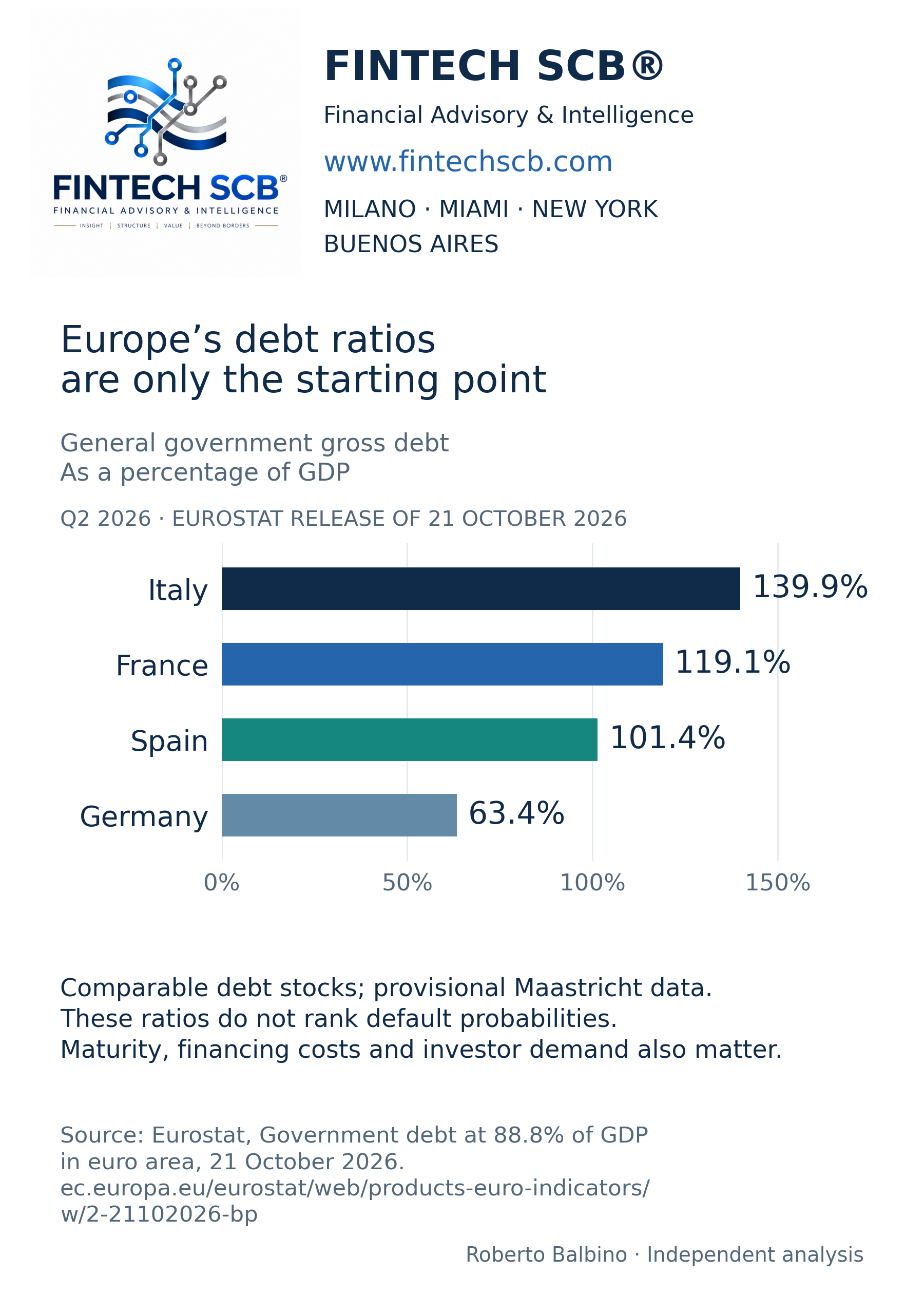
Eurostat’s 21 October release puts euro-area general government gross debt at 88.8% of GDP in the second quarter of 2026, compared with 88.4% in the first quarter. The corresponding country ratios include Italy at 139.9%, France at 119.1%, Spain at 101.4% and Germany at 63.4%. [1]
Debt securities account for 84.5% of the euro-area total. That makes the functioning of bond markets central to financing, although not every security matures or reprices at once.
The chart presents comparable stock measures for the four countries. It does not rank their probability of default. These are provisional Maastricht general-government gross-debt figures, not market values or central-government bond totals alone.