
Europe’s €10 Trillion Missing Link
Financing the future requires a different financial system.
The Sunday Long Read | 11 October 2026
Europe keeps asking how to catch up in artificial intelligence. A more uncomfortable question is what kind of financial system it has built to pay for the attempt.
A company with property, predictable cash flows and assets that can be repossessed speaks a language a bank understands. A company with researchers, software, substantial initial losses and an uncertain route to global scale presents a different proposition.
Both may be economically valuable. They require different forms of capital.
A system centred on deposits and bank lending can finance businesses with predictable revenues and collateral effectively. It struggles when the assets are intangible, losses arrive early and outcomes remain highly uncertain.
This is the starting point of our proposal at FINTECH SCB. Europe should build a permanent, competitive channel connecting long-term savings to professionally managed innovation finance. It should give that channel measurable objectives, institutional investors, commercial discipline and an explicit accounting of who bears losses.
The ambition should be aggressive. The implementation should be financially literate.
The €10 trillion figure needs an explanation
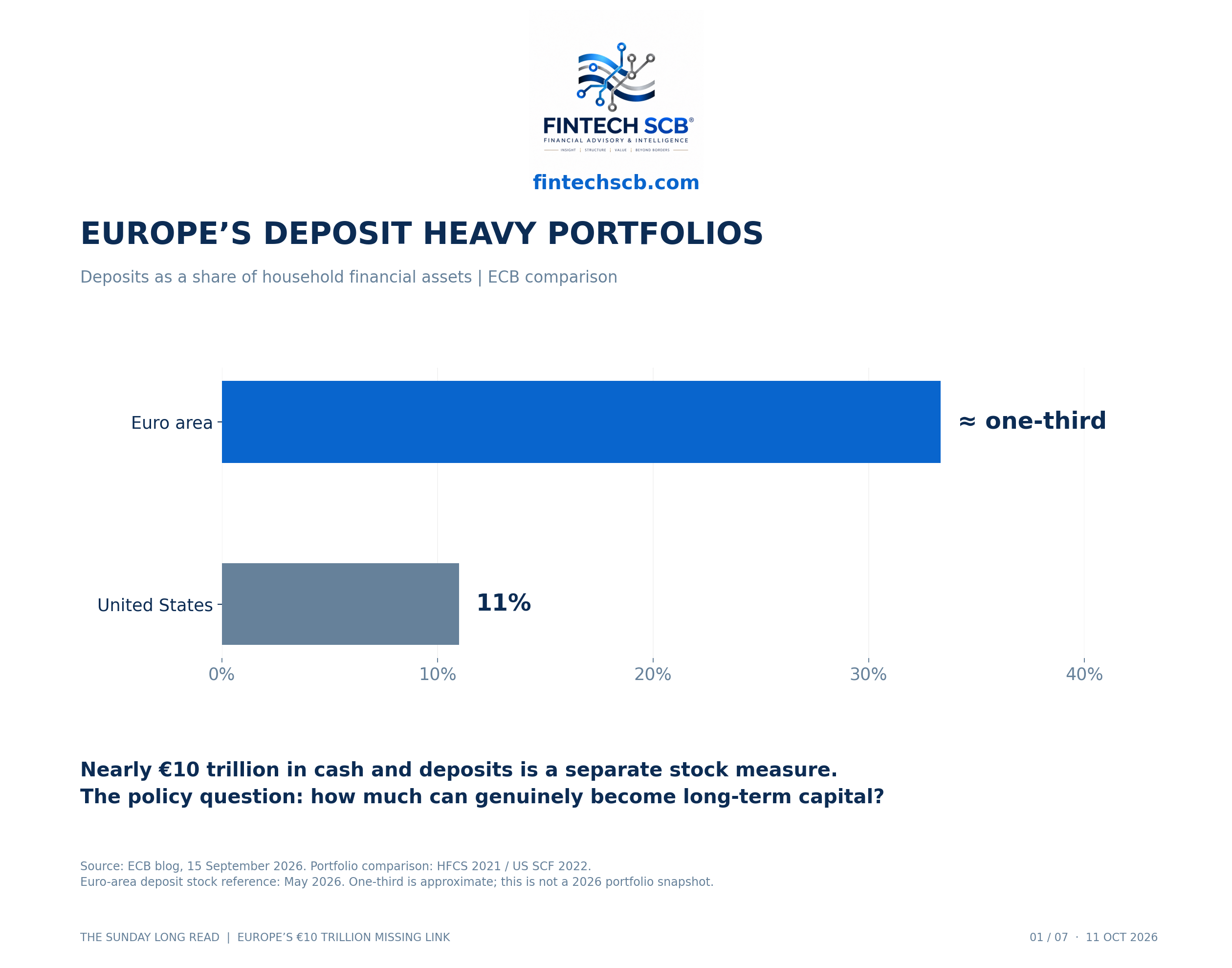
In September 2026, an ECB analysis highlighted nearly €10 trillion held by euro-area households in cash and bank deposits. Its portfolio comparison put deposits at approximately one-third of household financial assets in the euro area, against 11% in the United States.
The dates matter. The deposit-stock reference is May 2026. The portfolio comparison draws on the European HFCS 2021 wave and the US Survey of Consumer Finances 2022. These are separate observations, rather than one perfectly synchronised 2026 snapshot. “Euro area” also does not mean the whole of Europe. [1]