
China's Uneven Recovery
Factories surge. Investment retreats.
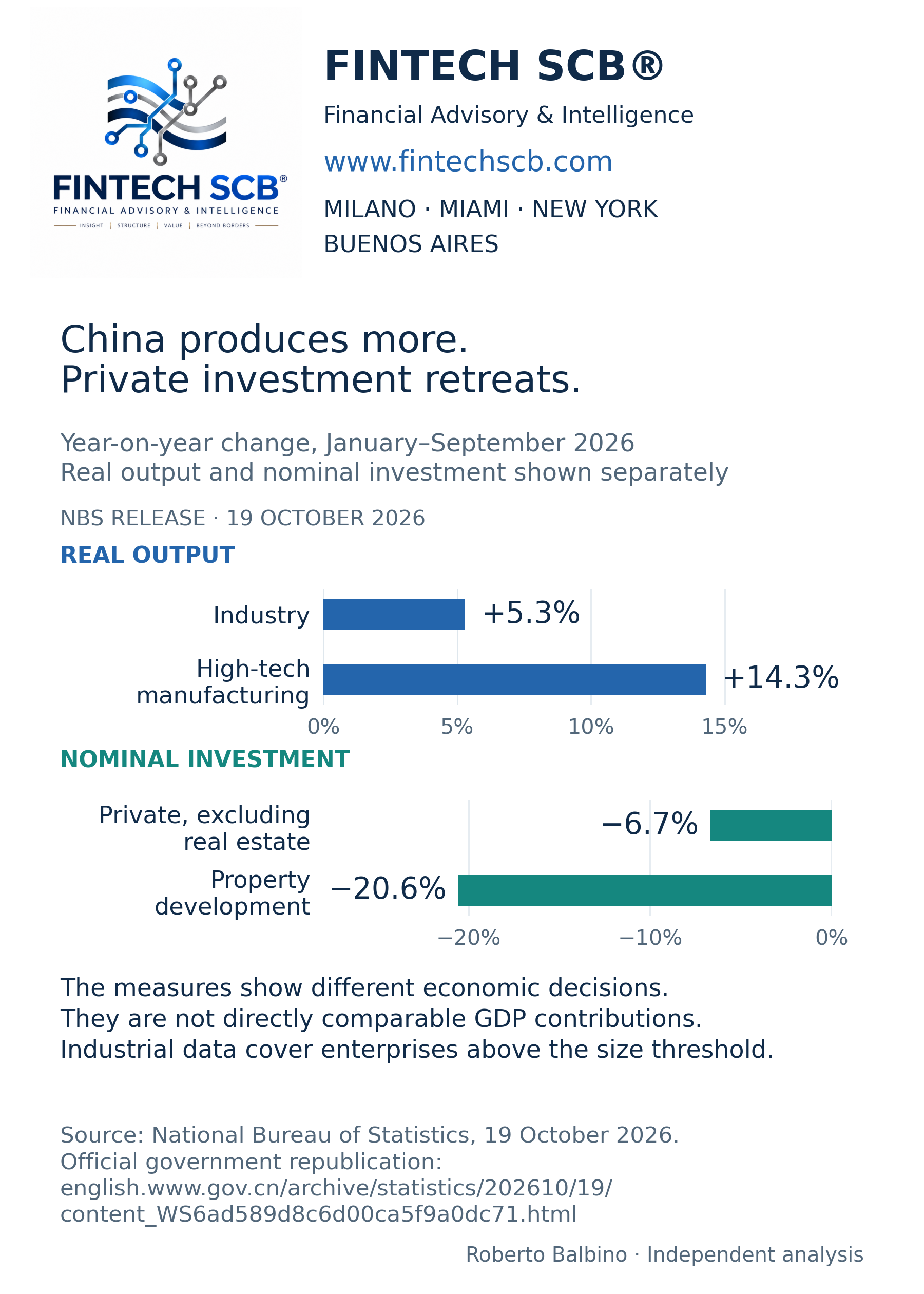
A factory can be busy while its owner decides against building the next one. An export order can rise while a household postpones buying an apartment. An economy can produce more without persuading its private sector that the future has become sufficiently attractive to invest in.
These are not contradictory statements. They describe different decisions, made by different people, over different time horizons.
China’s latest economic release makes that distinction particularly important. Reading the GDP headline alone produces a reassuring story of resilience. Reading the weakest investment numbers alone produces a story of collapse. Neither captures the structure of what is happening.
My interpretation is that China possesses substantial productive capabilities while its domestic economy still struggles to distribute confidence, income and investment incentives widely enough. Industrial strength can coexist with a weak appetite to commit private capital.
The risk for the rest of the world is not limited to a Chinese downturn. A China that remains highly competitive in production while domestic demand remains uneven can also intensify pressure on foreign producers and trade relationships.
The data behind the tension
The National Bureau of Statistics release of 19 October reports real GDP growth of 4.5% year on year in the third quarter and 4.6% for January–September. Over those nine months, industrial value added rose 5.3%, with high-tech manufacturing up 14.3%. [1]
Meanwhile, nominal private fixed-asset investment fell 10.4%; excluding real estate, it fell 6.7%. Property development investment declined 20.6%. These investment measures are not national-accounts contributions to GDP, and their nominal growth rates should not be compared mechanically with real output growth.