
The Green Paradox
The West wants clean cars. China built the dirty industrial system needed to make them.
There is something deeply paradoxical about the way the West has approached the electric-car revolution.
Europe wants to reduce emissions.
The United States has spent enormous sums trying to accelerate electrification and localise clean-energy manufacturing.
Consumers are encouraged — and increasingly pushed by regulation — toward vehicles that produce no emissions from an exhaust pipe.
But there is one inconvenient detail.
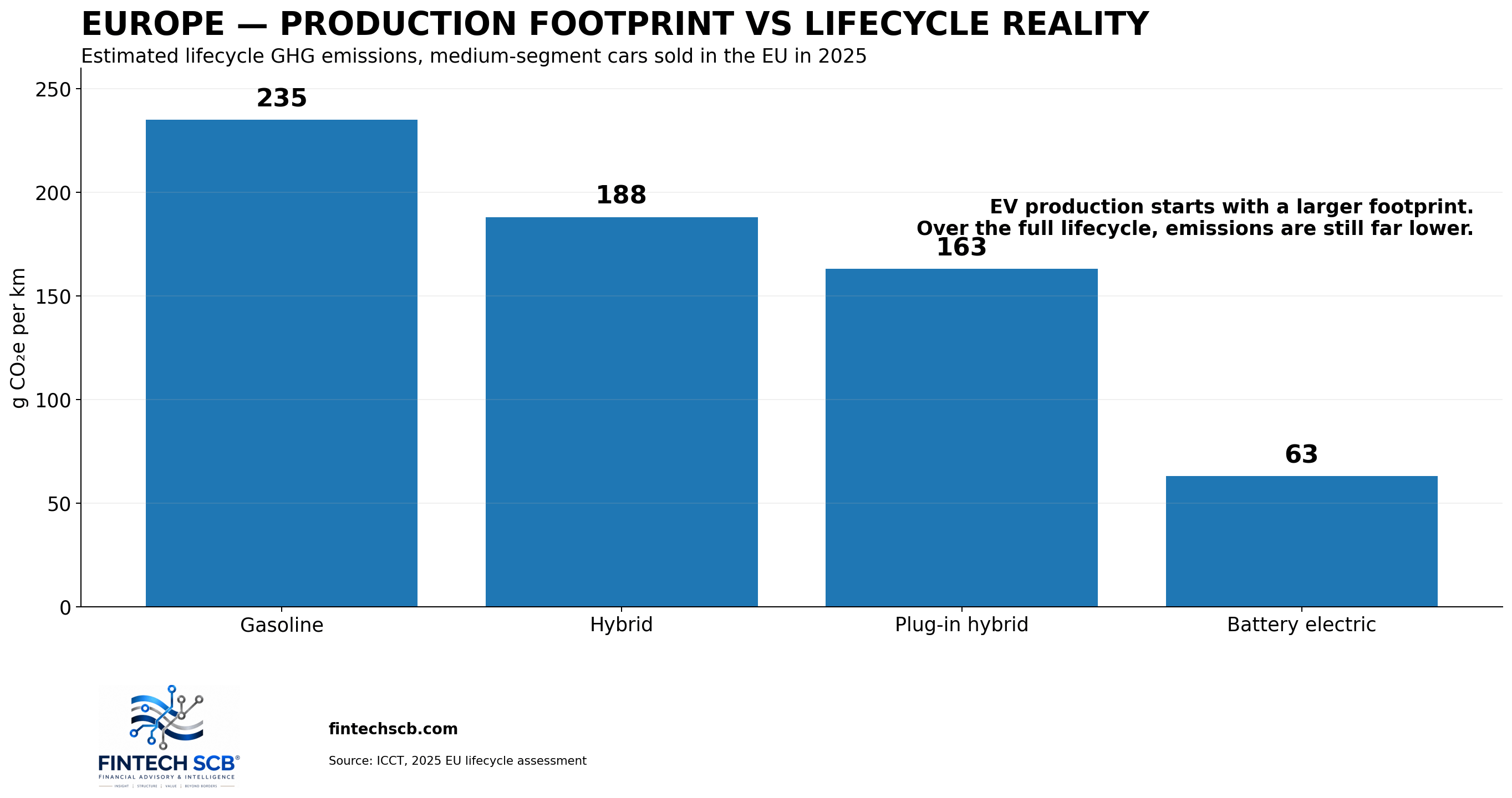
An electric car begins its life with a larger carbon footprint than a conventional car.
According to the ICCT’s latest European lifecycle assessment, producing a battery-electric vehicle generates approximately 40% more greenhouse-gas emissions than producing a conventional internal-combustion car, primarily because of the battery.
That does not mean electric cars are worse for the climate over their entire lives.
They are not.
But it does raise a question that has received remarkably little attention:
Where are those additional industrial emissions produced?
And an even more uncomfortable one:
Who controls the industrial system needed to satisfy the demand created by Western green policy?
Increasingly, the answer is China.
The electric car is clean where we drive it. Its production is not.
The political appeal of the electric vehicle is obvious.
No petrol.
No diesel.
No exhaust.
No tailpipe CO₂.
Drive through Milan, Paris, Berlin or Amsterdam and the vehicle itself produces no local exhaust emissions.
But environmental accounting cannot reasonably begin when a car enters a European showroom.
Before that vehicle exists, enormous industrial processes have already occurred.
Lithium, nickel, graphite, copper and other materials have been extracted.
Those materials have been processed and refined.