
EUROPE’S MISSING AI REVOLUTION
Stock Markets, Purchasing Power and the Strategic Cost of Technological Dependence
Europe has a paradox.
Its stock markets can rise.
Its companies can remain profitable.
Its households can recover part of the purchasing power lost during the inflation shock.
And yet Europe can still fall behind in the technological transformation that may determine productivity, corporate profits, wages, financial wealth and geopolitical power for the next generation.
This is the distinction that matters.
The question is not whether Europe is economically successful today.
The question is:
Who will own the technologies generating tomorrow’s economic rents?
Artificial intelligence is rapidly turning that question from a technological debate into a macroeconomic and geopolitical one.
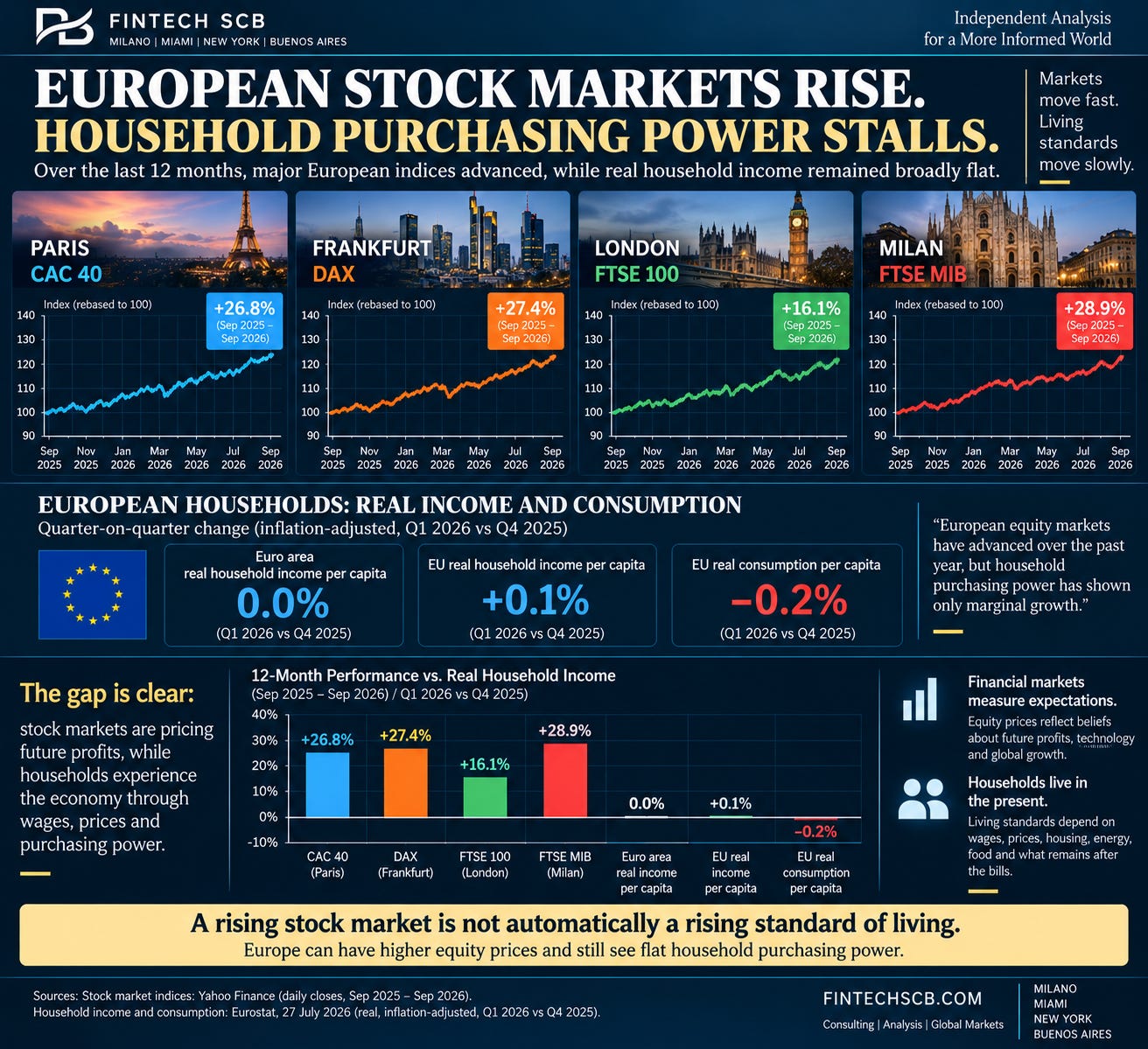
[INSERT CHART 1 — EUROPEAN STOCK MARKETS vs HOUSEHOLD PURCHASING POWER]
MARKETS CAN RISE WHILE PURCHASING POWER STALLS
Start with financial markets.
Paris.
Frankfurt.
London.
Milan.
The CAC 40, DAX, FTSE 100 and FTSE MIB represent four of Europe’s most important equity markets.
The first point to establish is important: Europe does not have a simple “stock markets do not rise” problem.
European equities can perform extremely well.
Now move from financial markets to households.
The picture becomes very different.
In Q1 2026, real household income per capita was unchanged quarter-on-quarter in the euro area.
Across the European Union, it increased just 0.1%.
Real household consumption per capita was unchanged in the euro area and declined 0.2% across the EU.
These figures are already adjusted for inflation.
This comparison must be interpreted carefully.
Stock-market returns and quarterly household-income growth are different measures covering different periods. I am not presenting one as the direct cause of the other.