
Europe Has Everything Except Power
The continent has the money, people, industry and knowledge to rival the United States and China. Its weakness is not economic size. It is political fragmentation.
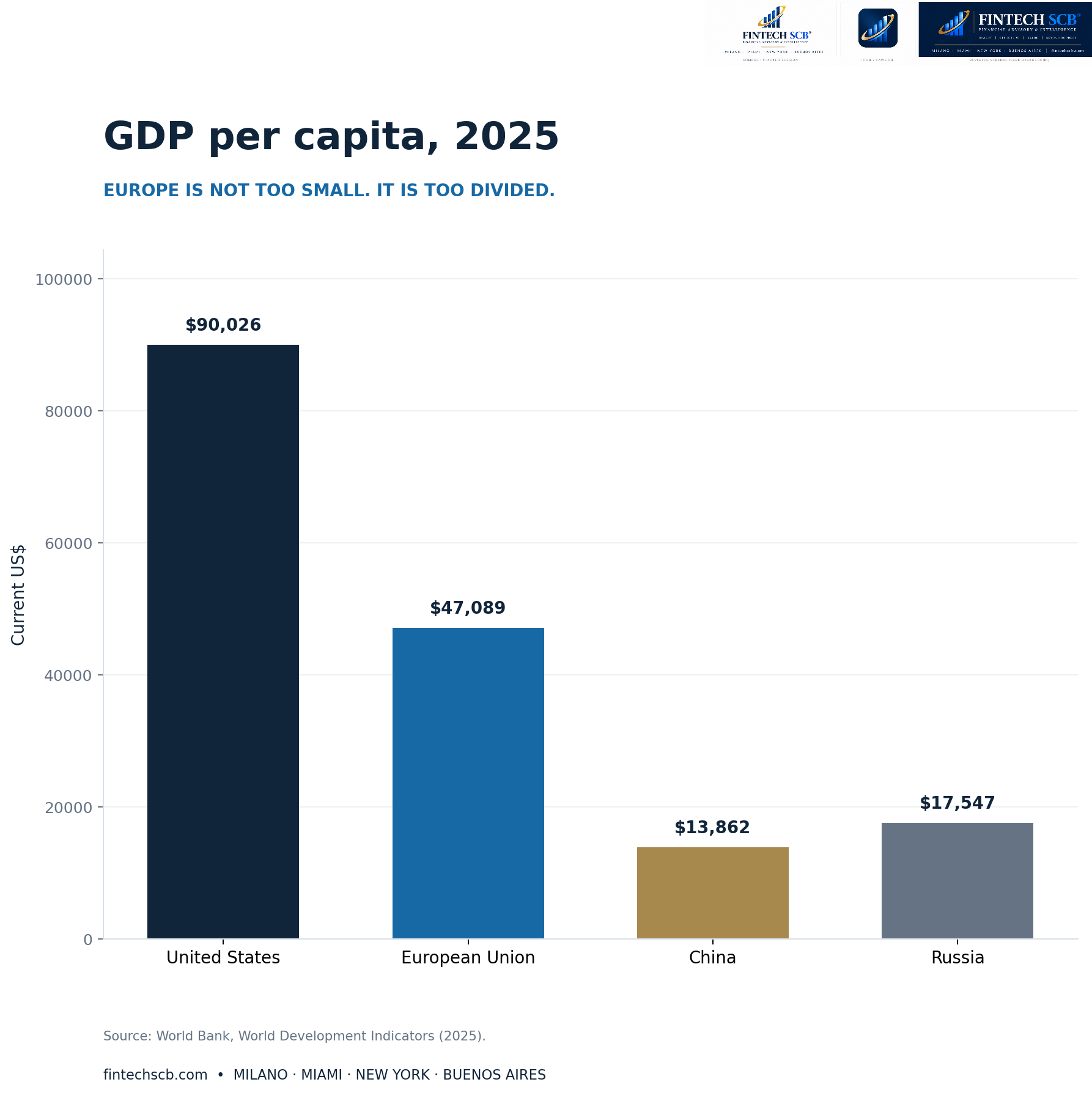
Europe likes to explain its decline through individual failures.
It was too slow on electric vehicles. Too cautious on artificial intelligence. Too fragmented on defence. Too dependent on American technology. Too bureaucratic for startups. Too reluctant to finance risk. Too divided to formulate a coherent industrial strategy.
Each explanation contains some truth. Taken separately, however, they obscure the larger problem.
Europe is not losing because it is small. Europe is losing because it has built the economic dimensions of a superpower without building the machinery that allows a superpower to use them.
That is a very different diagnosis.
The European Union has roughly 451 million inhabitants, substantially more than the United States. Its economy is worth about $21 trillion at current exchange rates, placing it in the same global league as America and China. It possesses some of the world’s strongest universities, sophisticated financial institutions, advanced manufacturing, enormous household savings, a major reserve currency and one of the largest consumer markets ever assembled.
This is not the profile of a weak economic area.
And yet Europe repeatedly produces less strategic power than the sum of its resources would suggest.
That is the European paradox.
The United States is simultaneously a market, a monetary union, a fiscal state, a military power and a political federation.
China is simultaneously a market, an industrial system, a fiscal state, a military power and a highly centralised political state.
Europe is a market.
And then, whenever the most consequential decisions begin, it often becomes 27 countries again.