
America Is Growing Without Hiring
AI, infrastructure and productivity are sustaining output and profits while job creation weakens. The new American boom may be real—but increasingly unable to make prosperity feel broadly shared.
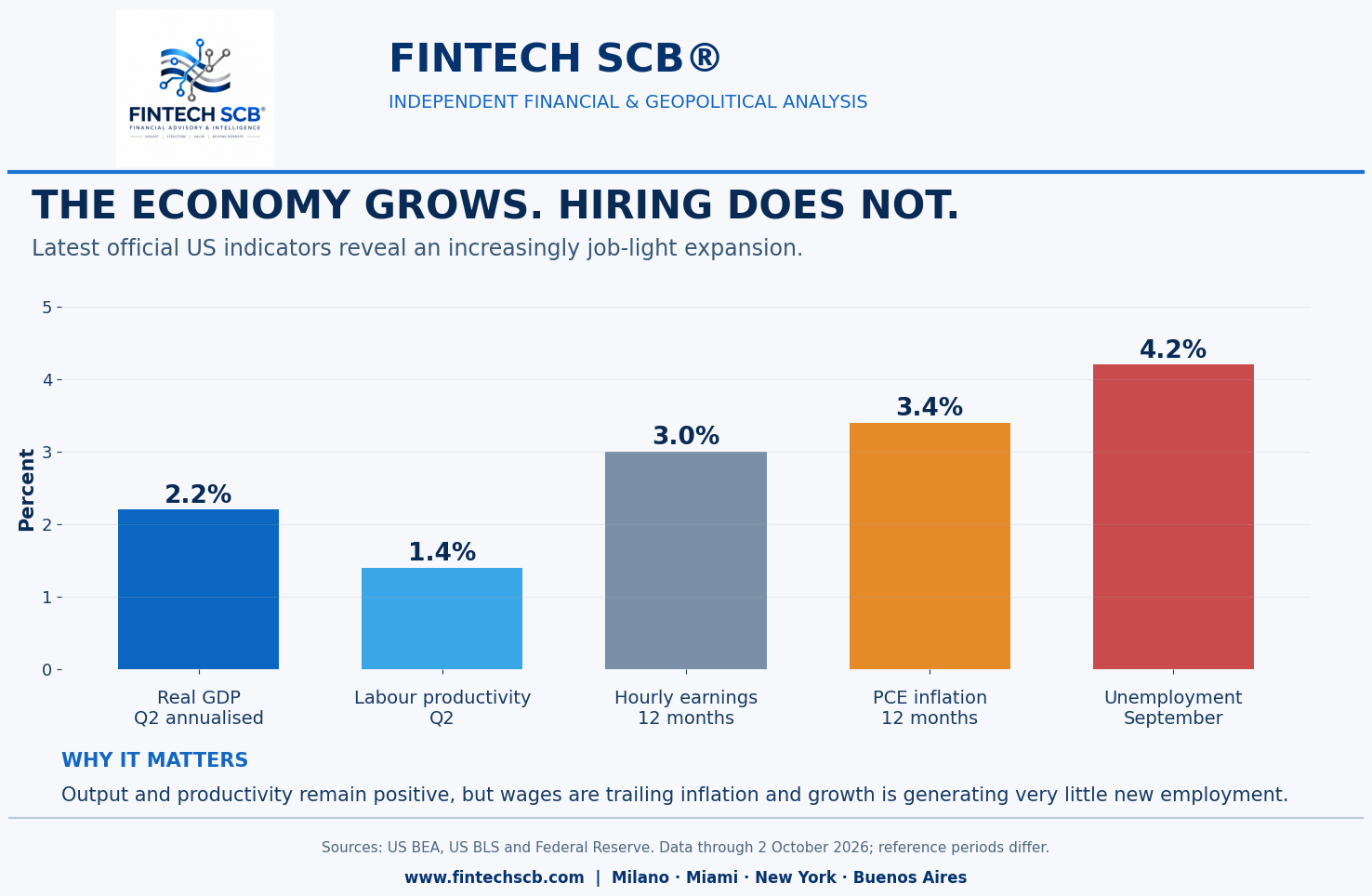
The American economy is still growing.
That is the first fact any serious analysis must acknowledge.
Real GDP expanded at an annualised rate of 2.2% in the second quarter of 2026, following revised growth of 2.5% in the first quarter. Measured across the first half of the year, Federal Reserve Vice Chair Philip Jefferson described economic growth as running at approximately 2.4%.
Business investment remains strong. Artificial-intelligence infrastructure, data centres, semiconductors, energy generation and advanced manufacturing continue to attract capital. Labour productivity is improving. Corporate profits remain supported. Financial markets continue to price a powerful technological transformation.
And yet the labour market is producing an entirely different signal.
The United States added just 29,000 non-farm payroll jobs in September. The average monthly increase over the previous twelve months was only 45,000. July and August were revised down by a combined 60,000 jobs.
Unemployment remains relatively low at 4.2%, but labour-force participation is stuck at 61.8%. Employment growth has slowed across almost every major industry. Financial activities have lost 129,000 jobs since their May 2025 peak, including 90,000 in insurance and related activities.
This is not yet a recession.
It may be something more structurally important: an economy that can expand without creating employment on the scale Americans have historically associated with economic growth.
The central question is therefore changing.
It is no longer simply whether the United States can avoid recession.
It is whether GDP, profits and asset values can continue rising while the connection between economic expansion and broadly shared employment becomes progressively weaker.