
AI’s Trillion-Dollar Money Loop
When the supplier finances the ecosystem, the ecosystem buys the supplier’s technology, and Wall Street finances the infrastructure, where does real demand begin?
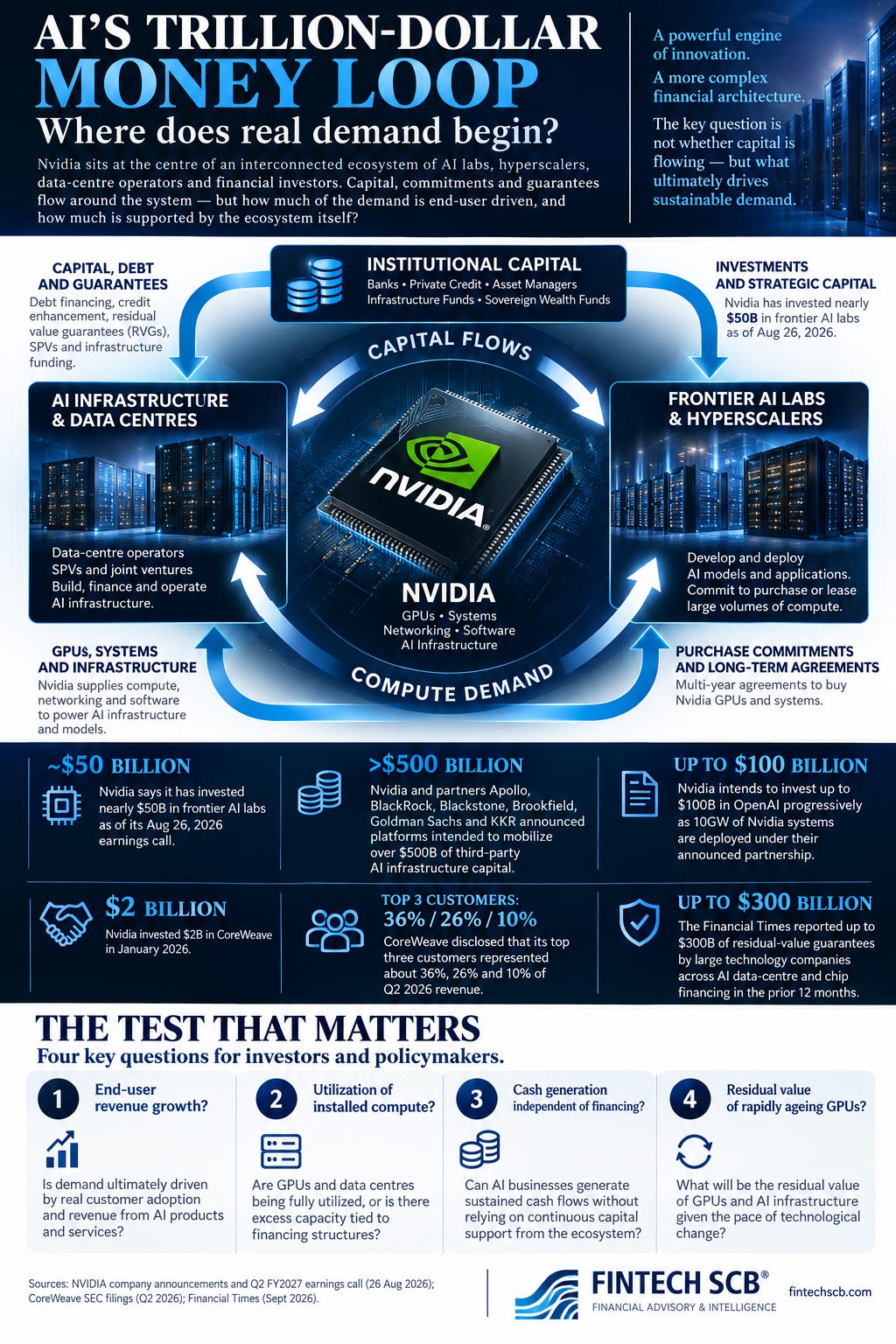
There is a very simple way to describe the artificial-intelligence boom.
Companies want more AI. AI requires more computing power. More computing power requires more GPUs. Nvidia supplies those GPUs.
That explanation is correct.
It is also becoming radically incomplete.
Behind the extraordinary expansion of AI infrastructure, a much more sophisticated financial architecture is emerging. Chipmakers, AI laboratories, hyperscalers, data-centre operators, private-credit funds, infrastructure investors and Wall Street banks are becoming increasingly interconnected.
Capital moves in one direction. GPUs move in another. Compute capacity is leased back through the system. Long-term purchase commitments support financing. Equity investments strengthen customers. Guarantees make infrastructure projects easier to finance.
And eventually much of that capital returns to the companies supplying the hardware.
This does not automatically mean that anything improper is happening.
But it creates a question investors should take very seriously:
How much AI demand is ultimately being generated by independent end customers — and how much is being accelerated by the financial architecture of the AI ecosystem itself?
That distinction may become one of the most important questions in global capital markets.
Nvidia is no longer merely selling chips
Nvidia’s role in this system has expanded dramatically.
It remains the dominant supplier of the computing infrastructure used to train and operate many frontier AI systems.
But Nvidia increasingly acts simultaneously as supplier, investor, ecosystem builder and facilitator of infrastructure finance.
On its August 26, 2026 earnings call, Nvidia said it had invested nearly $50 billion in frontier AI laboratories. The company also said that demand from AI labs for which it expects to use its balance sheet could account for roughly one-quarter of its business next year.